

Most horse care products promise shine, fragrance, and a pleasant feel when brushed through. Hardly anyone asks what happens to the skin in the process. Yet the skin is your horse's largest organ. It protects, it feels, it cools, and on it lives its own little world of microorganisms.
I have been working as a veterinary naturopath with skin cases for over 15 years and live with Icelandic horses myself. On this page, I will explain to you how horse skin is structured, what it does, and why it works differently from ours. Those who understand this care differently.
Tim Reinert Veterinary Naturopath and Founder
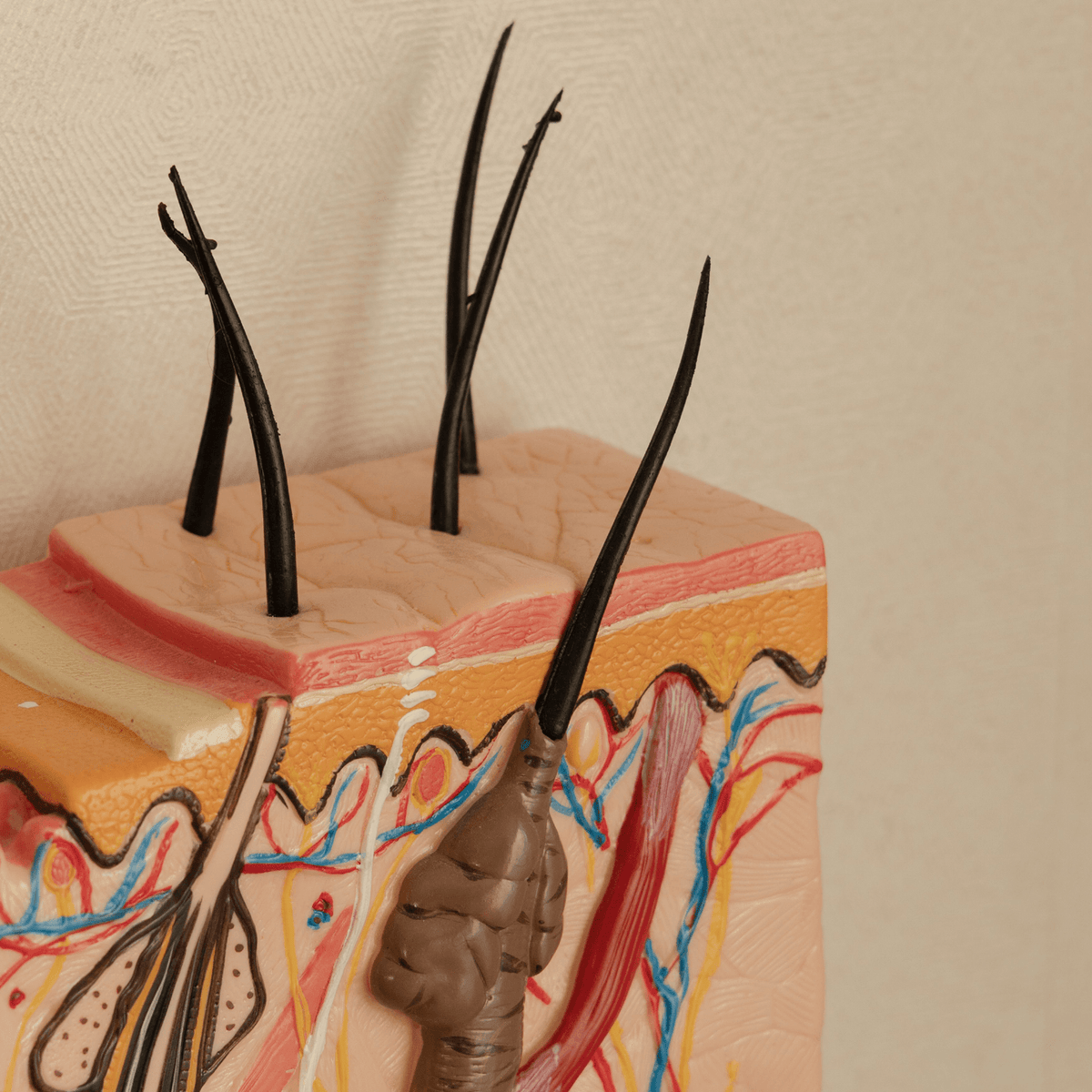
THREE LAYERS ONE MISSION
Horse skin consists of three main layers. On the very outside is the epidermis, which, depending on the area of the body, is only about 0.03 to 0.15 millimeters thick. Beneath that is the dermis, containing blood vessels, nerves, hair follicles, and glands. At the very bottom is the subcutaneous layer , a cushion of fat and connective tissue.
And living on all of this is the skin microbiome: billions of bacteria, yeasts, and fungi that are part of healthy skin.

THE LAYERS FROM THE OUTSIDE IN.
The skin microbiome
Bacteria, yeasts and fungi live on the skin's surface and in the hair follicles. They occupy the space that pathogens would otherwise inhabit and produce substances that inhibit unwanted germs. Their food is the film of sebum and sweat on the skin.
Horny layer (stratum corneum)
The outermost layer of the epidermis and the most important barrier. It consists of dead, keratinized cells that lie like bricks in a mortar of lipids: ceramides, cholesterol, and free fatty acids. This wall keeps water in the skin and pathogens out. In horses, it is thinner and more sensitive than in humans.
Granular layer (Stratum granulosum)
The last living cell layer before keratinization. This is where the corneocytes are formed, which later make up the mortar of the stratum corneum.
Prickle cell layer (stratum spinosum)
Firmly connected skin cells, interspersed with Langerhans cells, the sentinels of the immune system. This is where the skin's defense reaction begins, for example in response to insect bites.
Basal layer (stratum basale)
This is where the cells divide. New skin cells are constantly being produced, slowly migrating upwards, keratinizing, and eventually shedding as fine scales. The pigment cells are also located here. White marks lack pigment, which makes the skin there more sensitive to the sun.
Lizard skin (Dermis)
A dense network of collagen and elastin that gives the skin tensile strength and elasticity. The dermis contains blood vessels, nerves, hair follicles, sebaceous glands, and sweat glands. It supplies the avascular epidermis with nutrients through diffusion.
Subcutaneous tissue (subcutis)
Fat and loose connective tissue. It pads, insulates against the cold, stores energy, and makes the skin movable over the muscles.
HORSEHIDES IS NOT HUMAN SKIN
-
pH value
Human skin is acidic, around pH 5. Horse skin is in the neutral to slightly alkaline range, around pH 7 and above. Therefore, acidic formulas from human cosmetics are not suitable for horse skin.
-
Sweat
Horses sweat a protein-rich sweat through apocrine glands. The protein latherin makes it lather and helps it spread through the dense coat and cool it. Human sweat is watery and acidic.
-
Horn layer
The protective outer layer is thinner and more mechanically sensitive in horses. Aggressive washing and scrubbing wear it down more quickly.
-
Microbiome
On healthy horse skin, different groups of bacteria predominate than on human skin. Horses from the same stable have a more similar skin microbiome than horses from different stables.
THE SKIN MICROBIOME
Your horse's skin is home to its own community of bacteria, yeasts, and fungi. Most of these are not enemies, but allies. They occupy the skin's surface, making it harder for pathogens to gain a foothold. Chemical defense: They metabolize sebum and produce substances that inhibit unwanted germs. Immune training: Through constant contact, the skin's immune system learns to respond appropriately.
Care that completely removes sebum or seals the skin airtight also affects these cohabitants.
THE 6 FUNCTIONS OF THE SKIN
-
Barrier
Keeps water in the body and pathogens, dirt and irritants out.
-
Immune organ
Sentinel cells in the epidermis and dermis detect intruders and trigger immune responses.
-
Habitat
Makes room for the skin microbiome, which in turn protects the skin.
-
Air conditioning
Sweating, blood circulation, and goosebumps regulate body temperature.
-
Sensory organ
It perceives touch, pressure, temperature, and pain. That’s why your horse feels every fly.
-
Metabolism
Produces vitamin D with the help of sunlight and stores fat and water.

SUMMER - BODY LOTION

Care for sweet itch
Sweet itch is more than just a skin problem, which is why...
FOUR SEASONS FOUR SKIN CONSTRUCTION SITES
-
Spring:
Shedding, hay fever, start of grazing and change in feed, first crane flies. Allergy to early bloomers.
-
Summer:
Summer eczema, sweat and friction, sun on unpigmented skin. Insect and pollen allergies, dry skin,
-
Autumn:
Grass mites, rain scald, rain rot, skin fungus, ringworm, shedding problems. Metabolic problems
-
Winter:
Moisture under the coat and blankets, ringworm, mites, sebaceous gland problems, dust and feed mites
WHAT THROWS THE SKIN OUT OF BALANCE.
From the outside
Prolonged dampness softens the keratin layer. Washing too frequently with the wrong pH or harsh surfactants strips away barrier lipids and washes away the microbiome. Scratches, friction from equipment, and insect bites cause tiny injuries. And unpigmented skin reacts sensitively to strong sunlight.
From the inside
From my experience as a veterinary naturopath: skin problems are rarely just a skin issue. Diet, digestion, metabolism, stress, and parasites can manifest in the skin. That is why, in every case of skin problems, I also ask about food, stool, and living conditions.

WE THINK ABOUT CARE DIFFERENTLY
Hestakofi is the result of Fylkir's journey of suffering.
For years I watched him suffer, again and again every summer. His mane ruined, the surgical scar on his belly raw. I bought what the market had to offer, and always experienced the same thing: The products sat on the coat, made it shine, and smelled good. It changed nothing for his skin.
That's when I realized I was looking in the wrong place. Fylkir's problem wasn't on the coat. It was in the skin. In a barrier that was no longer intact. In immune cells that overreacted to every pinprick. In a microbiome that had fallen out of balance. And in a body that also had its say from within.
So I started to understand the skin layer by layer and formulate it myself. Not at a desk, but at the grooming stall, with him. In the autumn I had to let Fylkir go. But everything Hestakofi is today, he taught me. I didn't invent the name either: That was the name of my grandparents' farm.
On this page I share what I have learned about horse skin. So that you don't have to search in the wrong place for so long with your horse as I did.
We think horse skin.
SHOPFAQ
Can I wash my horse with human or baby shampoo?
Probably not. These products are formulated for the acidic skin of humans, while horse skin is neutral to slightly alkaline. Use a product designed for horses and use sparingly. Or just wash with water.
How often should I wash my horse?
As rarely as possible, as often as necessary. After riding, clear water is usually enough to remove sweat. Every shampoo also removes barrier lipids and microorganisms.
Why does horse sweat lather?
Because of latherin, a protein in horse sweat. It lowers the surface tension so that the sweat spreads through the coat and cools more effectively.
Are silicones in fur spray harmful?
Silicones form a film on the hair and skin. This adds shine and makes the coat brushable, but can build up with frequent use. Instead, we use plant-based oils that do not build up.
Why is the skin under thick winter fur an issue?
A thick coat, like that of the Icelandic horse, keeps moisture and warmth close to the skin. Part the coat regularly while grooming and check the skin underneath. This way, you’ll notice any changes early.
DO YOU HAVE ANY QUESTIONS?
Then call: 04101 / 80 54 040